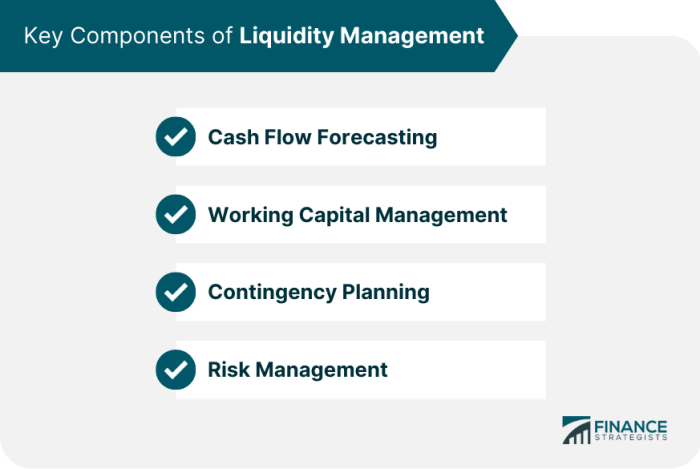
Maintaining sufficient liquidity is paramount for the financial health of any institution. Effective liquidity management isn’t just about having enough cash on hand; it’s a proactive, strategic process encompassing risk assessment, forecasting, and resource allocation. This involves understanding diverse liquidity sources, navigating regulatory landscapes, and adapting to fluctuating market conditions. Mastering these aspects ensures operational stability and resilience, even amidst economic uncertainty.
This exploration delves into the core principles of effective liquidity management, examining various assessment methods, tools, and techniques employed by financial institutions to mitigate liquidity risk. We will explore the regulatory environment, the impact of external factors, and future trends shaping this critical area of finance.
Defining Effective Liquidity Management
Effective liquidity management is crucial for the stability and survival of any financial institution. It involves strategically managing assets and liabilities to ensure sufficient funds are available to meet immediate obligations and withstand unexpected shocks. This proactive approach minimizes the risk of insolvency and maintains operational efficiency.Effective liquidity management rests on several core principles. First, maintaining an adequate buffer of liquid assets is paramount.
This buffer serves as a cushion against unexpected withdrawals or funding gaps. Second, accurate forecasting of cash inflows and outflows is vital. Reliable predictions allow for proactive adjustments to the institution’s liquidity position. Third, diversification of funding sources reduces reliance on any single source, mitigating risks associated with market fluctuations or counterparty defaults. Finally, robust monitoring and reporting systems are essential for tracking liquidity levels and identifying potential problems early.
Types of Liquidity
Understanding the different types of liquidity is essential for effective management. Liquidity can be broadly categorized into internal and external liquidity. Internal liquidity refers to the readily available cash and near-cash assets within the institution. This includes balances in deposit accounts, short-term investments, and readily marketable securities. External liquidity, on the other hand, refers to the institution’s ability to raise funds from external sources in case of need.
This includes access to credit lines, the ability to issue commercial paper, and the potential for borrowing from central banks or other financial institutions. Furthermore, it’s important to differentiate between high-quality liquid assets (HQLA), which can be quickly converted to cash with minimal loss, and less liquid assets, which may require more time and effort to sell.
Examples of Successful Liquidity Management Strategies
Several financial institutions have demonstrated effective liquidity management. For example, during the 2008 financial crisis, some banks that had proactively diversified their funding sources and maintained substantial liquidity buffers were able to weather the storm more effectively than those that relied heavily on short-term wholesale funding. Similarly, institutions with sophisticated early warning systems and robust stress testing capabilities were better prepared for unexpected liquidity shocks.
These strategies often involved proactive monitoring of key liquidity metrics, regular stress testing scenarios, and diversification of funding sources across various markets and instruments. These institutions also often implemented robust internal control systems and procedures to manage liquidity risks effectively.
Hypothetical Liquidity Risk Management Framework for a Small Financial Institution
A small financial institution could implement a framework centered around three key pillars: liquidity planning, monitoring, and response. The planning stage would involve developing a comprehensive liquidity risk assessment, identifying potential liquidity shocks (e.g., sudden deposit withdrawals, unexpected loan demand), and establishing liquidity targets and buffers. This would also include forecasting cash flows and identifying potential funding sources.
The monitoring pillar involves tracking key liquidity metrics (e.g., liquidity coverage ratio, net stable funding ratio), comparing actual performance against forecasts, and regularly reporting on liquidity status to senior management. Finally, the response pillar Artikels procedures to address liquidity shortfalls. This could involve drawing down on pre-arranged credit lines, selling liquid assets, or implementing contingency plans to manage potential disruptions.
Regular stress testing, using various scenarios, would form a crucial part of this framework. For instance, a scenario might simulate a sudden 20% reduction in deposits to assess the institution’s resilience. The institution would then adjust its liquidity buffer and funding strategies accordingly.
Liquidity Risk Assessment and Measurement
Effective liquidity risk management necessitates a robust framework for assessing and measuring potential shortfalls. This involves employing a variety of methods to understand the institution’s ability to meet its obligations as they come due, considering both the timing and the magnitude of cash flows. A comprehensive approach combines quantitative analysis with qualitative judgment to build a holistic picture of liquidity risk exposure.Liquidity risk assessment and measurement involves a multifaceted approach that goes beyond simply looking at readily available cash.
It delves into the intricacies of a financial institution’s funding sources, asset liquidity, and potential outflows under various scenarios. A strong understanding of these elements is critical for effective management and mitigation of liquidity risk.
Methods for Assessing and Measuring Liquidity Risk
Several methods are employed to assess and measure liquidity risk. These methods provide different perspectives on the institution’s liquidity position, allowing for a more comprehensive understanding of its vulnerabilities. The choice of methods often depends on the institution’s size, complexity, and regulatory environment.
- Liquidity Coverage Ratio (LCR): This metric, commonly used by banks, measures an institution’s ability to withstand a significant liquidity stress scenario over a 30-day period. It’s calculated as the ratio of high-quality liquid assets (HQLA) to total net cash outflows over the period. A higher LCR indicates greater resilience.
- Net Stable Funding Ratio (NSFR): Unlike the LCR, the NSFR focuses on the long-term stability of funding. It assesses the proportion of available stable funding to required stable funding over a one-year time horizon. This metric encourages institutions to maintain a more sustainable funding structure.
- Stress Testing: This involves simulating various adverse scenarios (e.g., market shocks, bank runs) to assess the institution’s ability to withstand unexpected liquidity pressures. The results highlight potential vulnerabilities and inform contingency planning.
- Liquidity Gap Analysis: This method compares the timing and amounts of expected cash inflows and outflows over a specified period. A negative gap indicates a potential liquidity shortfall, highlighting the need for mitigation strategies.
Comparison of Liquidity Risk Metrics
Different liquidity risk metrics offer unique perspectives on an institution’s liquidity profile. While the LCR emphasizes short-term resilience, the NSFR focuses on long-term funding stability. Stress testing provides a dynamic assessment under adverse conditions, while liquidity gap analysis provides a granular view of potential shortfalls. Each metric has its strengths and weaknesses, and a comprehensive assessment often involves using multiple metrics in conjunction.
For example, a high LCR might mask underlying vulnerabilities revealed by stress testing under a severe market downturn.
The Importance of Stress Testing in Liquidity Risk Management
Stress testing is crucial for proactively identifying and mitigating liquidity risks. By simulating various adverse scenarios, institutions can assess the effectiveness of their liquidity management strategies and identify potential weaknesses. This proactive approach allows for the development of contingency plans and the implementation of mitigating actions before a crisis occurs. Stress tests should incorporate a wide range of scenarios, including those that are unlikely but potentially catastrophic.
The severity and probability of each scenario should be carefully considered.
Hypothetical Scenario and Mitigation Strategies
Imagine a mid-sized regional bank experiencing a sudden, unexpected surge in deposit withdrawals due to unfounded rumors about its financial health. This rapid outflow of funds creates a significant liquidity gap, potentially jeopardizing the bank’s ability to meet its obligations. This scenario illustrates the impact of a liquidity crisis.To mitigate this crisis, the bank could implement several strategies:
- Emergency Borrowing: Secure short-term loans from other banks or central bank facilities to cover immediate funding needs.
- Asset Sales: Liquidate a portion of its less liquid assets to generate cash quickly. This might involve selling securities or other investments.
- Capital Injection: Seek additional capital from shareholders or other investors to bolster its financial position.
- Communication Strategy: Issue a public statement reassuring depositors and addressing the rumors to stem further withdrawals.
The effectiveness of these mitigation strategies depends on the severity of the crisis, the bank’s existing liquidity buffers, and the speed of its response. A swift and decisive response is essential to minimize the impact of a liquidity crisis.
Liquidity Management Tools and Techniques
Effective liquidity management relies on a robust toolkit of strategies and instruments. These tools allow financial institutions to anticipate and respond to fluctuations in cash flow, ensuring sufficient funds are available to meet obligations and capitalize on opportunities. The selection and implementation of these tools are crucial for maintaining financial stability and overall operational efficiency.
A range of tools and techniques are employed for effective liquidity management, each playing a unique role in safeguarding the institution’s financial health. These tools are not mutually exclusive and often work in concert to create a comprehensive liquidity risk management framework.
Cash Flow Forecasting
Accurate cash flow forecasting is the cornerstone of effective liquidity management. This involves projecting future inflows and outflows of cash, enabling institutions to anticipate potential shortfalls or surpluses. Sophisticated forecasting models, incorporating historical data, seasonal trends, and economic forecasts, are often used to generate detailed projections. These projections inform decisions regarding funding needs, investment strategies, and overall resource allocation.
For example, a bank anticipating a surge in loan repayments might strategically invest excess funds in short-term, highly liquid securities. Conversely, a company expecting a period of low sales might secure a short-term credit line to cover expenses. The accuracy of these forecasts is paramount; inaccurate projections can lead to liquidity mismatches and potentially serious financial consequences.
Borrowing Facilities
Access to diverse borrowing facilities provides a crucial safety net during periods of liquidity stress. These facilities offer flexibility in accessing funds quickly and efficiently. Common examples include overdraft facilities, short-term loans, commercial paper, and lines of credit. Each facility has its own terms and conditions, including interest rates, repayment schedules, and collateral requirements. Diversifying borrowing sources is essential to mitigate reliance on any single lender and to ensure access to funds even during periods of market instability.
For example, a corporation might maintain both a revolving credit facility with a bank and a commercial paper program to access short-term funds through multiple channels.
Asset-Liability Management (ALM)
ALM is a strategic approach to managing the balance sheet, aiming to optimize the institution’s asset and liability profile to minimize liquidity risk. This involves matching the maturity and liquidity of assets and liabilities, ensuring sufficient liquid assets are available to meet maturing liabilities. ALM considers factors such as interest rate risk, credit risk, and market risk. Effective ALM requires sophisticated modeling and forecasting techniques to predict future changes in interest rates, market conditions, and customer behavior.
For instance, a bank might adjust its lending portfolio to reduce exposure to longer-term, less liquid loans if it anticipates a period of increased demand for deposits.
Comparison of Short-Term and Long-Term Funding Sources
The choice between short-term and long-term funding sources depends on the institution’s specific needs and risk tolerance. The following table provides a comparison of several options:
| Funding Source | Cost | Availability | Risk |
|---|---|---|---|
| Overdraft | High (relative to other short-term options) | High (if pre-arranged) | Low (if properly managed) |
| Commercial Paper | Moderate | Moderate (dependent on credit rating) | Moderate (interest rate risk, refinancing risk) |
| Bank Loan (Short-term) | Moderate to High | High (if pre-approved) | Low to Moderate (depending on loan terms) |
| Bonds | Low to Moderate | Moderate (dependent on market conditions) | Moderate (interest rate risk, credit risk) |
Key Factors in Selecting Liquidity Management Tools
The selection of appropriate liquidity management tools depends on several critical factors. These include the institution’s size, business model, risk appetite, regulatory environment, and the overall economic outlook. A thorough assessment of these factors is crucial to ensure the chosen tools effectively mitigate liquidity risk while supporting the institution’s strategic objectives. For example, a small business might rely heavily on short-term lines of credit, while a large multinational corporation might employ a more sophisticated strategy involving a mix of short-term and long-term funding sources, including bond issuances.
Effective Communication and Collaboration
Effective communication and collaboration are essential for sound liquidity management. Open communication channels across departments – including treasury, finance, risk management, and senior management – ensure a shared understanding of liquidity risks and the strategies in place to address them. Collaboration facilitates the timely identification and resolution of potential liquidity issues, minimizing the impact on the institution’s operations and financial stability.
Regular reporting, scenario analysis, and stress testing exercises enhance transparency and promote a proactive approach to liquidity risk management. For example, a regular liquidity committee meeting, involving representatives from various departments, allows for a coordinated and informed response to changing market conditions and potential liquidity challenges.
Regulatory and Compliance Aspects of Liquidity Management
Effective liquidity management is not merely an internal matter for financial institutions; it’s a critical area overseen by regulatory bodies to ensure the stability of the financial system as a whole. These regulations aim to prevent liquidity crises and protect depositors and the broader economy. Failure to comply can have severe repercussions, impacting the institution’s reputation, financial health, and even its survival.Regulatory bodies play a crucial role in establishing and enforcing standards for liquidity risk management.
Their oversight ensures that financial institutions maintain adequate liquidity buffers to withstand unexpected shocks and maintain their operational stability. This framework of regulations promotes confidence in the financial system, reducing the risk of systemic events.
The Role of Regulatory Bodies in Overseeing Liquidity Management Practices
Regulatory bodies, such as central banks (e.g., the Federal Reserve in the US, the European Central Bank in the EU, the Bank of England in the UK) and other financial supervisory authorities, set minimum liquidity standards and conduct regular assessments of financial institutions’ liquidity positions. These assessments involve reviewing internal liquidity risk management frameworks, stress testing capabilities, and the adequacy of liquidity buffers.
They also monitor the overall liquidity conditions within the financial system, identifying potential vulnerabilities and implementing appropriate interventions when necessary. The specific requirements and approaches vary depending on the jurisdiction and the type of financial institution.
Examples of Relevant Regulations and Compliance Requirements for Financial Institutions
Several key regulations impact liquidity management. Basel III accords, for instance, introduced stricter capital and liquidity requirements for banks globally. These include the Liquidity Coverage Ratio (LCR), requiring banks to hold high-quality liquid assets sufficient to cover net cash outflows over a 30-day stress scenario, and the Net Stable Funding Ratio (NSFR), aiming to ensure that banks have a stable funding profile over a longer time horizon (typically one year).
Other examples include specific regulations related to reporting requirements, internal controls, and stress testing methodologies. The Dodd-Frank Act in the US, following the 2008 financial crisis, introduced numerous provisions to enhance liquidity risk management, including stricter oversight of systemically important financial institutions. These regulations often mandate detailed internal liquidity risk management frameworks, regular reporting to supervisory authorities, and robust stress testing exercises.
Best Practices for Ensuring Compliance with Liquidity Regulations
Maintaining compliance necessitates a multifaceted approach. Institutions should establish a robust and well-documented liquidity risk management framework, aligned with regulatory requirements and best practices. This includes clearly defined roles and responsibilities, regular liquidity monitoring and reporting, and comprehensive stress testing. Regular internal audits and independent reviews are essential to identify weaknesses and ensure the effectiveness of the framework.
Furthermore, maintaining open communication and collaboration with regulatory bodies is crucial. Proactive engagement with supervisors allows institutions to address potential issues early and demonstrate a commitment to compliance. A strong corporate culture that prioritizes liquidity risk management is also vital, ensuring that it’s not viewed solely as a compliance exercise but as a critical aspect of overall risk management.
Potential Consequences of Non-Compliance with Liquidity Regulations
Non-compliance can lead to severe consequences. Financial penalties and reputational damage are common outcomes. Regulatory actions can range from warnings and corrective actions to restrictions on operations or even license revocation. Furthermore, non-compliance can severely impact an institution’s access to funding, potentially triggering a liquidity crisis. In extreme cases, it can lead to insolvency and failure.
The potential financial and operational disruption caused by non-compliance can be significant, not only for the institution itself but also for the broader financial system. For example, the failure of a large institution due to liquidity issues can have cascading effects on other financial institutions and the economy as a whole.
Liquidity Management and Logistics Management
Liquidity management in finance and logistics management, while seemingly disparate, share underlying principles of efficient resource allocation and risk mitigation. Both fields grapple with the timely movement and availability of critical assets – cash in finance and goods in logistics – to meet operational demands and strategic objectives. Understanding the similarities and differences between these disciplines offers opportunities for cross-functional learning and improved operational efficiency.
Key Principles and Practices: A Comparison
Liquidity management in finance centers on maintaining sufficient cash and readily convertible assets to meet short-term obligations and unexpected demands. This involves forecasting cash flows, managing working capital, and securing lines of credit. Logistics management, conversely, focuses on the efficient flow of goods and information across the supply chain, encompassing procurement, warehousing, transportation, and delivery. While the assets differ (cash versus goods), both fields prioritize optimizing resource utilization, minimizing delays, and ensuring timely fulfillment of demands.
A key similarity is the reliance on forecasting and planning to anticipate future needs and proactively manage potential shortfalls. Differences lie primarily in the nature of the assets managed and the specific risks involved (e.g., credit risk in finance versus inventory obsolescence in logistics).
Risk Assessment and Mitigation Strategies
Financial liquidity risk assessment involves analyzing the probability and impact of not having enough cash to meet obligations. This typically includes stress testing scenarios like sudden economic downturns or loss of major customers. Mitigation strategies might involve maintaining cash reserves, establishing credit lines, and diversifying funding sources. In logistics, risk assessment focuses on potential disruptions to the supply chain, such as natural disasters, supplier failures, or transportation delays.
Mitigation strategies include diversification of suppliers, inventory buffers, and contingency planning for alternative transportation routes. Both fields use similar risk management frameworks, emphasizing proactive identification, assessment, and mitigation of potential disruptions. The specific risks and mitigation techniques, however, are tailored to the unique characteristics of each field.
Challenges and Opportunities in Integration
Integrating liquidity and logistics management within a large organization presents both challenges and opportunities. A significant challenge lies in aligning the different perspectives and priorities of finance and operations teams. Finance might prioritize minimizing cash holdings to maximize returns, while operations might favor larger inventory buffers to ensure uninterrupted production. Successfully integrating these functions requires strong cross-functional collaboration and a shared understanding of the interconnectedness of financial health and operational efficiency.
Opportunities arise from improved forecasting accuracy, optimized working capital management, and reduced supply chain costs. For example, improved demand forecasting can lead to more accurate cash flow projections and better inventory management, minimizing both financial and operational risks.
Best Practice Cross-Application
Best practices from one field can significantly enhance efficiency in the other. For instance, the sophisticated forecasting techniques used in financial liquidity management can be applied to improve demand forecasting in logistics, leading to more accurate inventory levels and reduced storage costs. Similarly, the robust contingency planning employed in logistics, particularly in managing supply chain disruptions, can inform financial risk management strategies, enhancing resilience to unexpected economic shocks.
The concept of just-in-time inventory management, prevalent in logistics, can be mirrored in finance by optimizing cash flow management to ensure sufficient liquidity without excessive cash holdings. This cross-pollination of best practices creates a synergistic effect, improving both financial stability and operational efficiency.
Future Trends in Liquidity Management
The landscape of liquidity management is undergoing a rapid transformation, driven by technological advancements and evolving market dynamics. Fintech innovations and the increasing adoption of artificial intelligence (AI) are reshaping how financial institutions assess, manage, and predict liquidity needs. This necessitates a proactive approach to adapting strategies and embracing new technologies to maintain financial stability and capitalize on emerging opportunities.The integration of fintech and AI presents both significant challenges and opportunities for effective liquidity management.
These technologies offer the potential for enhanced predictive capabilities, improved risk assessment, and streamlined operational processes. However, they also introduce new complexities related to data security, regulatory compliance, and the need for skilled personnel to manage these sophisticated systems.
Fintech and AI Applications in Liquidity Management
Fintech solutions are streamlining various aspects of liquidity management, from real-time cash flow forecasting to automated collateral management. AI-powered algorithms can analyze vast datasets to identify emerging liquidity risks, predict future cash flow patterns with greater accuracy, and optimize investment strategies for maximizing returns while maintaining sufficient liquidity buffers. For example, a machine learning model could analyze historical transaction data, market trends, and macroeconomic indicators to predict potential liquidity shortfalls with higher accuracy than traditional methods.
This allows for proactive adjustments to investment portfolios or borrowing strategies to mitigate potential risks. Furthermore, Robotic Process Automation (RPA) can automate repetitive tasks such as reporting and reconciliation, freeing up human resources for more strategic activities.
Challenges and Opportunities Posed by Technological Advancements
The adoption of new technologies presents several challenges. Data security and privacy concerns are paramount, particularly with the increasing reliance on cloud-based solutions and the sharing of sensitive financial data. Regulatory compliance requirements are also evolving rapidly, demanding continuous adaptation of systems and processes. The need for skilled personnel capable of managing and interpreting the output of sophisticated AI algorithms is also a critical factor.
However, these challenges are accompanied by significant opportunities. Improved predictive capabilities can lead to more efficient allocation of capital, reduced borrowing costs, and enhanced profitability. Automation can increase operational efficiency and reduce the risk of human error. The ability to analyze vast datasets can provide a deeper understanding of liquidity risks and opportunities, leading to more informed decision-making.
Adapting Liquidity Management Strategies to Evolving Market Conditions
The global financial landscape is characterized by increasing volatility and uncertainty. Geopolitical events, economic shocks, and regulatory changes can significantly impact liquidity conditions. Therefore, liquidity management strategies must be dynamic and adaptable to respond effectively to these evolving conditions. This necessitates the development of robust contingency plans, stress testing scenarios, and the establishment of clear communication channels between different departments within the financial institution.
For instance, a financial institution might incorporate scenario planning into its liquidity risk management framework, simulating the impact of various adverse events (e.g., a sudden increase in interest rates, a significant market downturn) on its liquidity position. This allows the institution to identify potential vulnerabilities and develop appropriate mitigation strategies in advance.
Hypothetical Liquidity Management Strategy for a Rapidly Changing Technological Environment
A hypothetical liquidity management strategy for a financial institution operating in a rapidly changing technological environment would incorporate several key elements. First, it would leverage AI-powered tools for predictive analytics and real-time monitoring of liquidity positions. Second, it would implement robust cybersecurity measures to protect sensitive data and maintain operational resilience. Third, it would establish a framework for continuous monitoring and adaptation of the strategy in response to evolving market conditions and regulatory changes.
Fourth, it would invest in training and development to ensure that staff possess the necessary skills to manage and interpret the output of sophisticated technologies. Finally, it would foster a culture of innovation and experimentation to explore and adopt new technologies as they emerge. This holistic approach would enable the institution to maintain sufficient liquidity while capitalizing on the opportunities presented by technological advancements.
Successfully navigating the complexities of liquidity management requires a multifaceted approach. From robust risk assessment and proactive planning to leveraging appropriate tools and adhering to regulatory compliance, a well-structured liquidity management framework is essential for financial stability. By understanding the interplay between internal strategies and external market forces, financial institutions can bolster their resilience and ensure long-term sustainability.
The continuous evolution of the financial landscape necessitates ongoing adaptation and innovation in liquidity management strategies, making it a dynamic and crucial area of focus.
FAQ Insights
What is the difference between short-term and long-term liquidity?
Short-term liquidity refers to readily available funds for immediate obligations, typically within a year. Long-term liquidity involves resources accessible over an extended period, supporting long-term investments and strategic goals.
How does technology impact liquidity management?
Technology, particularly fintech and AI, enhances forecasting accuracy, automates processes, and improves real-time monitoring of liquidity positions, leading to more efficient management.
What are the consequences of poor liquidity management?
Poor liquidity management can lead to missed payment obligations, damaged credit ratings, difficulty securing funding, and potentially even insolvency.
How can a small financial institution improve its liquidity management?
Small institutions can benefit from establishing clear liquidity policies, diversifying funding sources, utilizing cash flow forecasting tools, and proactively monitoring their liquidity position.