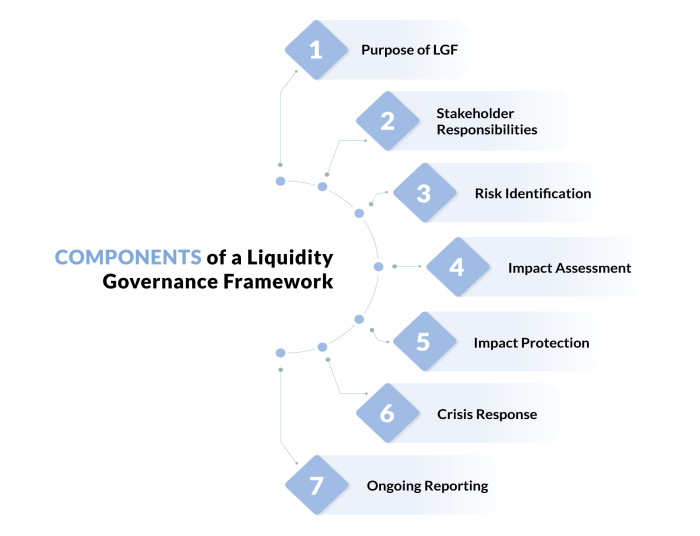
Effective liquidity risk management is crucial for the financial health of any organization, from small businesses to multinational corporations. Understanding the intricacies of liquidity risk, encompassing both funding and trading aspects, is paramount in preventing crises. This guide delves into the multifaceted nature of liquidity risk, exploring its measurement, management strategies, regulatory frameworks, and the impact of technological advancements.
We will examine various methodologies, including the Liquidity Coverage Ratio (LCR) and Net Stable Funding Ratio (NSFR), and discuss how stress testing and incorporating market factors are vital components of a robust risk assessment. Furthermore, we’ll explore how effective liquidity risk management integrates with broader operational strategies, drawing parallels with logistics management and highlighting the importance of robust reporting and monitoring.
Defining Liquidity Risk
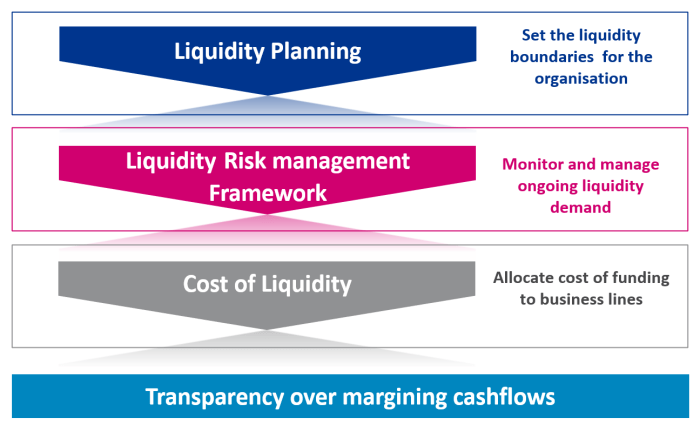
Liquidity risk is a critical concern for financial institutions, representing the potential inability to meet immediate payment obligations when they come due. It’s essentially the risk of not having enough readily available cash or assets that can be quickly converted into cash to cover short-term liabilities. This risk can significantly impact a firm’s stability and even lead to insolvency if left unmanaged.
Understanding the different facets of liquidity risk is crucial for effective risk management strategies.Liquidity risk manifests in several ways, broadly categorized as funding liquidity risk and trading liquidity risk. These categories represent different aspects of a financial institution’s ability to meet its obligations and maintain operational stability. Both are interconnected and a problem in one area can easily exacerbate issues in the other.
Funding Liquidity Risk
Funding liquidity risk arises from the inability to obtain sufficient funds to meet immediate obligations, such as withdrawals by depositors, repayment of debt, or settlement of transactions. This risk is heavily dependent on the institution’s access to funding sources and the stability of those sources. A sudden loss of confidence in the institution, for example, can lead to a rapid outflow of deposits, making it difficult to meet obligations.
This is particularly relevant for banks and other deposit-taking institutions. A bank might find itself unable to meet customer withdrawal requests if a large number of depositors simultaneously demand their funds, exceeding the bank’s readily available cash reserves.
Trading Liquidity Risk
Trading liquidity risk focuses on the ability to sell assets quickly without significantly impacting their market price. This is crucial for institutions holding large portfolios of securities or other assets. If an institution needs to liquidate a substantial portion of its portfolio quickly, it might have to accept a lower price than desired, resulting in a loss. This risk is especially pronounced during periods of market stress, when prices can fluctuate wildly and trading volume can be significantly reduced.
Imagine a hedge fund needing to sell a large block of a relatively illiquid stock; finding buyers quickly might prove difficult, forcing the fund to sell at a discounted price to meet margin calls or other obligations.
Events Triggering Liquidity Crises
Several events can trigger liquidity crises. These include, but are not limited to, unexpected large withdrawals of deposits (bank runs), sudden market downturns leading to large losses and reduced asset values, credit rating downgrades reducing access to funding, failures of counterparties resulting in unfulfilled obligations, and regulatory changes impacting capital requirements or liquidity ratios. The 2008 global financial crisis serves as a stark reminder of how rapidly liquidity problems can escalate into systemic crises.
The collapse of Lehman Brothers, for instance, triggered a massive liquidity crunch across the financial system, as counterparties scrambled to secure their own positions, leading to widespread market freezes and significant economic disruption.
Liquidity Risk Management Strategies
Effective liquidity risk management is crucial for the financial health and stability of any organization, regardless of size or industry. A robust strategy proactively addresses potential shortfalls in cash flow, ensuring the entity can meet its immediate and short-term obligations. This involves a multi-faceted approach encompassing various techniques and proactive planning.
Diversification of Funding Sources
Diversifying funding sources is a cornerstone of effective liquidity risk management. Reliance on a single source exposes the organization to significant vulnerability should that source become unavailable. A diversified approach, incorporating a mix of short-term and long-term funding options from various lenders and investors, significantly reduces this risk. For example, a company might secure a line of credit from a bank, issue commercial paper in the short-term debt market, and potentially access longer-term financing through bonds or private equity.
This strategy reduces the impact of any single funding source drying up.
Maintaining Adequate Cash Reserves
Holding sufficient cash reserves acts as a buffer against unexpected liquidity shocks. The optimal level of reserves depends on factors such as the organization’s size, industry, and operational characteristics. A general rule of thumb is to maintain enough cash to cover operating expenses for a specific period (e.g., three to six months). However, this should be tailored to the specific risk profile of the organization.
Companies with volatile cash flows or those operating in uncertain economic environments may need to hold significantly larger reserves. Furthermore, readily accessible short-term investments can supplement cash reserves, providing liquidity while earning a small return.
Establishing Lines of Credit
Securing lines of credit from financial institutions provides access to readily available funds in case of unexpected liquidity needs. These pre-approved credit facilities offer flexibility and speed, enabling swift responses to unforeseen circumstances. The terms and conditions of the line of credit, such as interest rates, fees, and borrowing limits, should be carefully negotiated to align with the organization’s liquidity risk tolerance.
Having a line of credit acts as a safety net, offering confidence that funding is available when required, even during periods of market stress.
Hypothetical Liquidity Risk Management Plan for a Small Bank
A small bank could implement a liquidity risk management plan incorporating the following elements: Firstly, a robust cash management system to monitor daily cash flows and forecast future needs. Secondly, diversification of funding sources through deposits, interbank borrowing, and potentially short-term debt issuance. Thirdly, maintaining a minimum level of liquid assets (e.g., government bonds) to meet regulatory requirements and cover unexpected withdrawals.
Fourthly, establishing lines of credit with correspondent banks to access emergency funding if needed. Finally, regular stress testing to assess the bank’s resilience to various liquidity scenarios, such as a sudden surge in withdrawals or a disruption in interbank markets. This plan would need regular review and adjustment to reflect changing market conditions and the bank’s evolving risk profile.
Liquidity Management Techniques: Large Corporations vs. Small Businesses
Large corporations typically employ sophisticated liquidity management techniques, including treasury management systems, advanced forecasting models, and complex hedging strategies. They often have access to a wider range of funding sources and can utilize sophisticated financial instruments to manage their liquidity risk. In contrast, small businesses generally rely on simpler methods, such as maintaining adequate cash reserves, negotiating favorable payment terms with suppliers, and establishing lines of credit.
They may have less access to diverse funding sources and may rely more heavily on personal guarantees or relationships with local banks. While large corporations can utilize complex hedging strategies to mitigate interest rate and currency risks, small businesses often lack the resources and expertise for such strategies. The difference primarily stems from resources, scale, and access to financial markets.
Liquidity Risk Monitoring and Reporting
Effective liquidity risk management relies heavily on robust monitoring and reporting systems. These systems provide crucial insights into a firm’s ability to meet its short-term obligations and ensure its continued operational stability. Regular monitoring allows for proactive identification of potential liquidity shortfalls, enabling timely intervention and mitigation strategies.
Key Performance Indicators (KPIs) for Liquidity Risk Monitoring
Monitoring liquidity risk requires a comprehensive set of key performance indicators (KPIs). These KPIs provide a quantitative assessment of a firm’s liquidity position and its vulnerability to liquidity shocks. The specific KPIs used will vary depending on the nature and size of the institution, but some common examples include:
| KPI | Description | Interpretation | Example |
|---|---|---|---|
| Liquidity Coverage Ratio (LCR) | The ratio of high-quality liquid assets to net cash outflows over a 30-day stress scenario. | Measures a bank’s ability to withstand a significant liquidity stress event. A higher ratio indicates greater resilience. | An LCR of 120% suggests the institution has sufficient high-quality liquid assets to cover its net cash outflows for 30 days under a stressed scenario. |
| Net Stable Funding Ratio (NSFR) | The ratio of available stable funding to required stable funding over a one-year time horizon. | Assesses the long-term stability of a bank’s funding structure. A higher ratio indicates a more stable funding profile. | An NSFR of 110% suggests that the institution has sufficient stable funding to meet its long-term obligations. |
| Cash Ratio | The ratio of cash and cash equivalents to total liabilities. | A simple measure of immediate liquidity. A higher ratio indicates greater immediate liquidity. | A cash ratio of 10% means that 10% of the institution’s liabilities are covered by immediately available cash. |
| Days Sales Outstanding (DSO) | The average number of days it takes to collect payments from customers. | Indicates the efficiency of accounts receivable management. A higher DSO suggests potential liquidity issues. | A DSO of 45 days implies that, on average, it takes 45 days to collect payments from customers. |
Sample Liquidity Risk Report
A comprehensive liquidity risk report should provide a clear and concise overview of a firm’s liquidity position, highlighting both strengths and weaknesses. The report should include both quantitative and qualitative assessments, using visualizations to enhance understanding. A sample report might include the following sections:
| Section | Data Points | Visualization |
|---|---|---|
| Liquidity Ratios | LCR, NSFR, Cash Ratio, DSO, etc. | Bar chart comparing current ratios to regulatory requirements and historical trends. |
| Funding Sources | Breakdown of funding sources (deposits, borrowings, etc.) | Pie chart showing the proportion of each funding source. |
| Cash Flow Projections | Forecasted cash inflows and outflows over a specified period. | Line graph showing projected cash balances over time. |
| Stress Testing Results | Results of simulations under various stress scenarios. | Table summarizing the impact of different stress scenarios on key liquidity metrics. |
Importance of Regular Reporting and Escalation Procedures
Regular reporting on liquidity risk is crucial for proactive management. Reports should be produced at predetermined intervals (e.g., daily, weekly, monthly), allowing for timely identification of emerging risks. Clear escalation procedures should be defined to ensure that significant liquidity events are promptly addressed. This includes specifying thresholds for triggering alerts and defining the responsible parties for taking corrective action.
Failure to establish and follow these procedures can lead to significant financial losses and reputational damage.
Successfully navigating the complexities of liquidity risk requires a proactive and multifaceted approach. By understanding the various types of liquidity risk, implementing appropriate measurement and management strategies, adhering to regulatory guidelines, and leveraging technological advancements, organizations can significantly mitigate their exposure to financial instability. The case studies presented underscore the critical importance of robust planning and continuous monitoring to ensure long-term financial resilience.
Essential Questionnaire
What is the difference between funding liquidity risk and trading liquidity risk?
Funding liquidity risk is the risk that an institution will be unable to meet its obligations as they come due, while trading liquidity risk is the risk that an institution will be unable to quickly liquidate assets without significant losses.
How often should liquidity risk be reported?
The frequency of reporting varies depending on the size and complexity of the institution and regulatory requirements, but it is generally recommended to report at least monthly, with more frequent reporting during periods of market stress.
What role does technology play in improving liquidity risk management?
Technology enables more sophisticated stress testing, real-time monitoring of liquidity positions, and improved data visualization, leading to more effective risk management and quicker responses to emerging threats.
What are some common consequences of poor liquidity risk management?
Poor liquidity risk management can lead to financial distress, bankruptcy, loss of investor confidence, and damage to reputation. In severe cases, it can trigger a systemic crisis.