Effective liquidity management is the cornerstone of any financially healthy business, regardless of size. It’s about more than just having enough cash on hand; it’s about strategically managing inflows and outflows to ensure operational stability and seize growth opportunities. This guide explores the essential tools and strategies that empower businesses to navigate the complexities of cash flow and mitigate financial risks.
From forecasting software to short-term investment options and insightful financial ratio analysis, we delve into the diverse landscape of liquidity management. We’ll examine how to implement these tools effectively, integrate them into existing systems, and leverage them to minimize risk and maximize profitability. The journey will include real-world examples and case studies illustrating successful strategies and lessons learned from navigating liquidity challenges.
Definition and Importance of Liquidity Management Tools
Liquidity management tools are the methods and systems businesses employ to ensure they have sufficient readily available cash to meet their short-term obligations. This involves monitoring cash flow, forecasting future needs, and strategically managing assets to maintain an optimal level of liquidity. Effective liquidity management is crucial for the ongoing operational health and financial stability of any business.Effective liquidity management is vital for businesses of all sizes, though the scale and complexity of the strategies employed will vary.
For small businesses, maintaining sufficient cash flow to cover immediate expenses like payroll and rent is paramount. Larger corporations, with more complex financial structures and operations, require more sophisticated tools and strategies to manage large sums of money, fluctuating demands, and potentially global operations. Maintaining healthy liquidity allows businesses to seize opportunities, weather unexpected downturns, and maintain a strong credit rating.
Consequences of Poor Liquidity Management
Insufficient liquidity can lead to severe financial distress and potentially business failure. Late payments to suppliers can damage relationships and lead to supply chain disruptions. Inability to meet payroll obligations can result in employee dissatisfaction and legal issues. Missed loan payments can damage credit ratings and restrict future access to financing. Ultimately, a lack of liquidity can force businesses into bankruptcy or liquidation.
For example, a small retail business experiencing unexpectedly low sales during a slow season might find itself unable to pay rent or suppliers, leading to closure if they haven’t proactively managed their cash reserves. A larger company, conversely, might face a liquidity crisis if they overextend themselves through aggressive expansion without adequately managing their cash flow and access to credit.
Types of Liquidity Management Tools
The following table compares several common liquidity management tools:
| Tool | Description | Advantages | Disadvantages |
|---|---|---|---|
| Cash Forecasting Software | Software that predicts future cash inflows and outflows based on historical data and projected sales. | Improved accuracy of cash flow predictions, proactive identification of potential shortfalls. | Requires accurate data input, can be expensive for sophisticated software. |
| Short-Term Investments | Investments in highly liquid assets like money market funds, Treasury bills, or commercial paper. | Provides a safe and readily accessible reserve of cash, earns a small return. | Returns are typically low compared to other investments, may involve small fees. |
| Line of Credit | Pre-approved loan that allows businesses to borrow money as needed up to a certain limit. | Provides quick access to funds during emergencies or unexpected expenses. | Involves interest charges, may require collateral. |
| Factoring | Selling accounts receivable to a third-party factoring company at a discount. | Provides immediate cash inflow, improves cash flow predictability. | Receives less than the full value of receivables, may damage relationships with customers. |
Types of Liquidity Management Tools
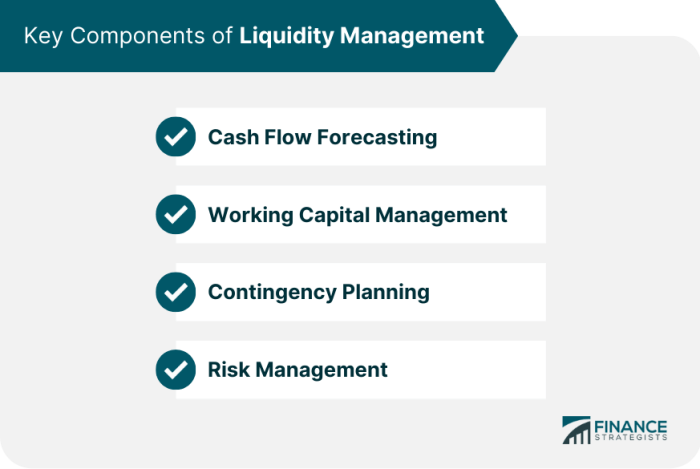
Effective liquidity management requires a multifaceted approach, utilizing various tools and strategies to ensure a company maintains sufficient cash flow to meet its short-term obligations while optimizing its investment opportunities. The selection of appropriate tools depends on factors such as the company’s size, industry, and risk tolerance.
Liquidity management tools can be broadly categorized into short-term financing options, cash flow forecasting and management software, and financial ratio analysis. Each plays a vital role in maintaining a healthy liquidity position and mitigating financial risks.
Short-Term Financing Options
Short-term financing options provide businesses with readily available funds to cover immediate cash flow needs. These options typically have maturities of less than one year. The choice of financing depends on factors such as the cost of borrowing, the availability of collateral, and the company’s creditworthiness.
Examples include:
- Lines of credit: A pre-approved loan that allows a company to borrow funds up to a specified limit as needed. This provides flexibility and avoids the need for repeated loan applications.
- Commercial paper: Short-term, unsecured promissory notes issued by corporations to raise funds. This is a cost-effective option for creditworthy companies.
- Trade credit: Credit extended by suppliers to businesses, allowing them to delay payment for goods or services. This is a common and often interest-free source of short-term financing.
- Factoring: Selling accounts receivable to a third party at a discount to receive immediate cash. This accelerates cash flow but comes at a cost.
- Bank overdrafts: Borrowing funds beyond the available balance in a company’s bank account. This is a short-term solution for temporary cash shortfalls.
Cash Flow Forecasting and Management Software
Sophisticated software solutions are crucial for accurate cash flow forecasting and proactive liquidity management. These tools provide real-time visibility into cash inflows and outflows, enabling businesses to anticipate potential shortfalls and plan accordingly.
Examples of such software include:
- Intuit QuickBooks: A widely used accounting software with robust cash flow management features, including forecasting and reporting tools.
- Xero: Another popular cloud-based accounting software offering similar functionalities to QuickBooks, with a focus on ease of use and real-time data.
- Sage 50cloud: A comprehensive accounting and business management software that incorporates cash flow forecasting and other financial planning tools.
These software solutions often incorporate features like automated bank reconciliation, invoice processing, and customizable reporting dashboards, enhancing the efficiency and accuracy of cash flow management.
Financial Ratios for Liquidity Assessment
Several financial ratios are used to assess a company’s liquidity position and its ability to meet its short-term obligations. These ratios provide valuable insights into the health of a company’s finances.
Key liquidity ratios include:
- Current Ratio: Calculated as Current Assets / Current Liabilities. A ratio above 1 indicates the company has sufficient current assets to cover its current liabilities.
- Quick Ratio (Acid-Test Ratio): Calculated as (Current Assets – Inventory) / Current Liabilities. This is a more stringent measure of liquidity, excluding less liquid inventory.
- Cash Ratio: Calculated as (Cash + Cash Equivalents) / Current Liabilities. This is the most conservative measure, focusing solely on the most liquid assets.
Analyzing these ratios over time and comparing them to industry benchmarks provides valuable insights into a company’s liquidity trends and its relative strength compared to its peers.
Comparison of Liquidity Management Strategies
Different liquidity management strategies offer varying levels of risk and reward. A conservative strategy prioritizes maintaining high levels of liquidity, potentially sacrificing investment opportunities. An aggressive strategy may maximize investment returns but carries a higher risk of liquidity shortfalls.
A comparison of these strategies is complex and depends heavily on specific circumstances, but generally:
| Strategy | Advantages | Disadvantages |
|---|---|---|
| Conservative | Reduced risk of liquidity crises, greater financial stability. | Lower returns on excess cash, missed investment opportunities. |
| Aggressive | Higher potential returns on investments, efficient use of capital. | Increased risk of liquidity shortages, potential for financial distress. |
The optimal strategy involves finding a balance between maintaining sufficient liquidity to meet obligations and maximizing returns on available funds. This requires careful monitoring of cash flows, proactive forecasting, and a flexible approach to financing.
Implementing Liquidity Management Tools
Implementing a robust liquidity management system requires a strategic approach encompassing careful planning, tool selection, and ongoing monitoring. A well-structured system ensures a company can meet its short-term obligations while optimizing its cash flow and minimizing financial risks. This process involves a series of steps, considerations, and ongoing monitoring activities.
Step-by-Step Implementation Process
The implementation of a liquidity management system unfolds in a phased approach. First, a thorough assessment of the company’s current financial position, including cash flow projections, is crucial. This initial assessment forms the basis for identifying areas needing improvement and setting realistic goals. Next, the selection of appropriate liquidity management tools, tailored to the company’s specific needs and size, is essential.
Following the selection, the integration of these tools into existing financial systems requires careful planning and execution, ensuring seamless data flow and reporting. Finally, ongoing monitoring and adjustments are necessary to adapt to changing market conditions and business requirements. This iterative process ensures the liquidity management system remains effective and responsive.
Key Considerations When Selecting Liquidity Management Tools
Choosing the right liquidity management tools is paramount. Several factors influence this decision. The size and complexity of the company’s operations significantly impact the required level of sophistication in the tools. Consideration should also be given to the integration capabilities with existing accounting and financial systems. The cost of implementation and ongoing maintenance is another critical factor.
Finally, the user-friendliness and ease of use of the chosen tools should not be overlooked; they must be readily accessible and understandable by the relevant personnel. Selecting tools that align with the company’s specific needs and resources is vital for successful implementation.
Essential Factors to Monitor During Liquidity Management
Continuous monitoring is vital to the effectiveness of any liquidity management system. Key metrics to track include cash balances, short-term debt levels, and upcoming payment obligations. Analyzing cash flow projections against actual performance provides early warnings of potential liquidity issues. Regular review of the company’s credit rating and access to credit facilities is equally important. Furthermore, monitoring key performance indicators (KPIs) related to accounts receivable and payable turnover helps in optimizing cash flow.
This consistent monitoring allows for proactive adjustments and prevents potential liquidity crises.
Best Practices for Integrating Liquidity Management Tools with Existing Financial Systems
Successful integration of liquidity management tools with existing financial systems hinges on meticulous planning and execution. Data compatibility between different systems must be carefully assessed and addressed. Robust data security measures are essential to protect sensitive financial information. Regular data backups and disaster recovery plans should be in place. Furthermore, establishing clear roles and responsibilities for data management and system maintenance is crucial for efficient operation.
A phased approach to integration, starting with pilot testing and gradual rollout, minimizes disruption and allows for adjustments along the way.
Liquidity Management and Risk Mitigation
Effective liquidity management is crucial for the financial health and stability of any organization. By proactively managing cash flow and ensuring sufficient readily available funds, businesses can significantly reduce their exposure to various financial risks and enhance their overall resilience. A robust liquidity management strategy provides a buffer against unexpected events and allows for the timely fulfillment of obligations, maintaining operational efficiency and investor confidence.Effective liquidity management directly reduces financial risks by providing a safety net against unforeseen circumstances.
Maintaining adequate liquidity minimizes the chances of defaulting on payments to creditors, suppliers, or employees. It also enables businesses to seize profitable opportunities as they arise, without being constrained by cash flow limitations. This proactive approach contributes to a stronger credit rating, lower borrowing costs, and increased investor confidence.
Potential Risks of Inadequate Liquidity Management
Inadequate liquidity management exposes businesses to a range of significant risks. The most prominent is the risk of insolvency, where a company lacks the necessary funds to meet its short-term obligations. This can lead to bankruptcy, loss of reputation, and potential legal action. Furthermore, a lack of liquidity can hinder business growth by preventing investments in new projects, technology upgrades, or expansion opportunities.
It can also negatively impact operational efficiency, as delays in payments to suppliers may disrupt the supply chain. Finally, inadequate liquidity can make a business vulnerable to opportunistic takeovers or distressed asset sales.
Strategies for Mitigating Liquidity Risk
Mitigating liquidity risk requires a multi-faceted approach that combines proactive planning, robust monitoring, and contingency measures. This includes developing accurate cash flow forecasts, establishing diverse funding sources, maintaining sufficient cash reserves, and implementing effective risk management procedures. Regular monitoring of key liquidity indicators, such as the current ratio and quick ratio, allows for early detection of potential problems.
Diversifying funding sources reduces reliance on any single lender or funding mechanism, improving resilience to market fluctuations. Furthermore, maintaining a sufficient level of readily available cash reserves acts as a buffer against unexpected expenses or revenue shortfalls.
Contingency Planning for Liquidity Shortfalls
A comprehensive contingency plan is essential for addressing potential liquidity shortfalls. This plan should Artikel specific actions to be taken in various scenarios, including identifying potential sources of emergency funding, such as lines of credit, asset sales, or equity financing. Pre-negotiated agreements with lenders can expedite access to funds during crises. The plan should also include communication protocols for informing stakeholders of any liquidity challenges.
Regular stress testing and scenario planning help to identify vulnerabilities and refine the contingency plan.
Potential Liquidity-Impacting Scenarios and Solutions
The following scenarios could negatively impact a company’s liquidity, along with potential solutions:
- Scenario: Unexpected increase in raw material costs. Solution: Negotiate longer payment terms with suppliers, explore alternative suppliers, or implement cost-cutting measures.
- Scenario: Significant drop in sales revenue due to economic downturn. Solution: Reduce operating expenses, implement a cost-reduction strategy, explore government support programs, and consider a temporary reduction in workforce (with appropriate support).
- Scenario: Major equipment failure requiring unexpected repairs. Solution: Draw down on a line of credit, secure short-term financing, or temporarily defer non-essential investments.
- Scenario: Loss of a major client. Solution: Diversify client base, actively pursue new business opportunities, and implement cost-cutting measures to offset revenue loss.
- Scenario: Natural disaster impacting operations. Solution: Activate business interruption insurance, secure emergency funding, and implement business continuity plans.
Mastering liquidity management is not merely about survival; it’s about thriving. By understanding the various tools available and implementing a robust strategy, businesses can confidently navigate economic uncertainties, capitalize on opportunities, and achieve sustainable growth. This guide has provided a framework for building a strong foundation in liquidity management, empowering you to make informed decisions and ensure the long-term financial health of your organization.
Continuous monitoring and adaptation are key to navigating the ever-evolving financial landscape.
Question Bank
What are the key indicators of poor liquidity?
Key indicators include consistently high debt levels, difficulty meeting short-term obligations, declining sales, and a shrinking cash reserve.
How often should a company review its liquidity position?
Regular review, ideally monthly, is recommended to identify potential issues early and adjust strategies proactively. More frequent reviews may be necessary during periods of uncertainty.
Can small businesses benefit from liquidity management tools?
Absolutely. Even small businesses can benefit significantly from improved cash flow forecasting and management, enabling better planning and resource allocation.
What role does technology play in modern liquidity management?
Technology plays a crucial role, automating processes, providing real-time insights, and enabling more sophisticated forecasting and analysis through software solutions.