Effective corporate liquidity management is the cornerstone of financial stability and sustainable growth. It involves strategically managing a company’s cash flow, short-term and long-term assets, and liabilities to ensure sufficient funds are available to meet operational needs, seize opportunities, and withstand unexpected financial shocks. This guide explores the key principles, techniques, and challenges associated with this critical aspect of corporate finance, offering insights into best practices and the impact of both internal and external factors.
From assessing liquidity risk and implementing robust forecasting models to leveraging technology and navigating the complexities of corporate governance, we delve into the multifaceted nature of liquidity management. Understanding these dynamics empowers businesses to optimize their financial health, minimize vulnerabilities, and ultimately, achieve greater success in a dynamic and ever-changing economic landscape.
Defining Corporate Liquidity Management
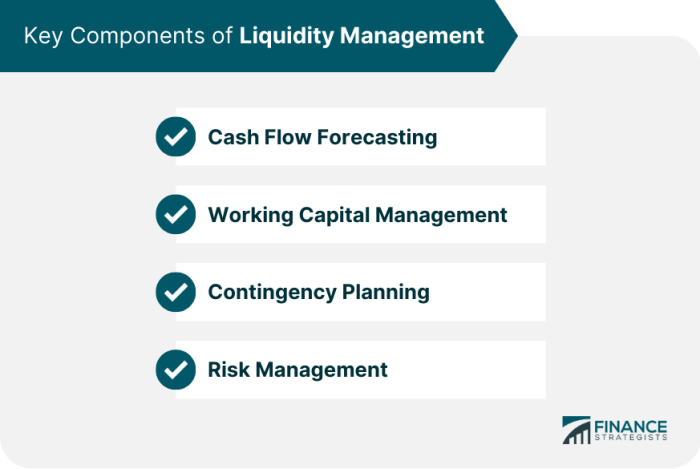
Corporate liquidity management is the process by which a company ensures it has enough readily available cash to meet its short-term obligations while also maintaining sufficient funds for strategic investments and unforeseen circumstances. It’s a crucial function impacting a company’s financial health, operational efficiency, and overall resilience.Effective corporate liquidity management hinges on several core principles. These include accurately forecasting cash flows, maintaining adequate cash reserves, efficiently managing working capital, and securing access to readily available funding sources.
A well-structured liquidity management plan helps mitigate financial risks, seize opportunities, and maintain operational stability.
The Importance of Optimal Liquidity Levels
Maintaining optimal liquidity levels is paramount for a corporation’s survival and success. Insufficient liquidity can lead to missed payments, damaged credit ratings, and ultimately, bankruptcy. Conversely, excessive liquidity can represent an opportunity cost, as idle cash could be invested to generate higher returns. The goal is to strike a balance—holding enough cash to cover immediate needs and anticipated expenses while minimizing the risk of cash shortages and maximizing the return on invested capital.
This balance is often determined by factors such as industry norms, business cycles, and the company’s risk tolerance. For example, a company in a volatile industry might maintain higher liquidity levels than a company in a stable sector.
Liquidity Management Strategies
Corporations employ various strategies to manage their liquidity effectively. These strategies can be broadly categorized as proactive and reactive. Proactive strategies focus on anticipating and mitigating potential liquidity issues before they arise, while reactive strategies address existing liquidity problems. Proactive strategies include robust cash flow forecasting, efficient inventory management, and securing lines of credit. Reactive strategies include drawing down on existing credit lines, selling assets, or raising additional capital through debt or equity financing.
A well-rounded approach typically incorporates both proactive and reactive elements. For instance, a company might proactively forecast cash flow needs for the next quarter and then reactively secure a short-term loan if unforeseen expenses arise.
Short-Term and Long-Term Liquidity Management Techniques
The following table compares common short-term and long-term liquidity management techniques:
| Technique | Category | Description | Example |
|---|---|---|---|
| Trade Credit | Short-Term | Delaying payments to suppliers. | Negotiating extended payment terms with suppliers. |
| Short-Term Loans | Short-Term | Borrowing funds for a short period. | Securing a line of credit from a bank. |
| Inventory Management | Short-Term | Optimizing inventory levels to minimize storage costs and maximize cash flow. | Implementing a Just-in-Time inventory system. |
| Factoring | Short-Term | Selling accounts receivable to a third party at a discount. | Selling invoices to a factoring company to receive immediate cash. |
| Long-Term Debt Financing | Long-Term | Issuing bonds or taking out long-term loans. | Issuing corporate bonds to raise capital for expansion. |
| Equity Financing | Long-Term | Raising capital by issuing new shares of stock. | Conducting an Initial Public Offering (IPO). |
| Asset Sales | Long-Term | Selling non-essential assets to generate cash. | Selling a subsidiary or underperforming business unit. |
| Capital Budgeting | Long-Term | Careful planning and evaluation of capital expenditures. | Analyzing the profitability of a new factory before investing. |
Liquidity Management and Corporate Governance
Effective corporate governance plays a crucial role in ensuring robust liquidity management. A well-defined governance structure fosters transparency, accountability, and proactive risk mitigation, ultimately safeguarding the financial health of the organization. This section examines the interconnectedness of liquidity management and corporate governance, highlighting key aspects for optimal performance.
The Board of Directors’ Oversight of Liquidity Management
The board of directors bears ultimate responsibility for overseeing the company’s overall financial health, including its liquidity position. This involves establishing a clear framework for liquidity risk management, reviewing regular reports on liquidity metrics, and ensuring the implementation of appropriate policies and procedures. Specific responsibilities include approving the company’s liquidity policy, setting acceptable levels of liquidity risk, and monitoring the effectiveness of management’s actions in maintaining adequate liquidity.
The board should also receive regular briefings from management on the company’s liquidity position, including any potential risks or challenges. They should challenge management’s assumptions and ensure that contingency plans are in place to address potential liquidity shortfalls. Independent directors, due to their objectivity, play a particularly crucial role in this oversight function.
Key Performance Indicators (KPIs) for Monitoring Liquidity
Several key performance indicators (KPIs) are vital for effectively monitoring a company’s liquidity. These KPIs provide a comprehensive view of the company’s ability to meet its short-term obligations. Effective monitoring requires a balanced approach, considering both short-term and long-term liquidity needs.
- Current Ratio: This ratio (Current Assets / Current Liabilities) indicates the company’s ability to pay its short-term liabilities with its short-term assets. A ratio above 1 suggests sufficient liquidity, while a ratio below 1 may indicate potential liquidity issues.
- Quick Ratio: This is a more stringent measure ( (Current Assets – Inventory) / Current Liabilities) that excludes inventory, which may not be readily convertible to cash. A higher quick ratio signifies stronger short-term liquidity.
- Cash Ratio: This ratio ( (Cash + Cash Equivalents) / Current Liabilities) provides the most conservative assessment of liquidity, focusing solely on readily available cash.
- Days Sales Outstanding (DSO): This KPI measures the average number of days it takes to collect payments from customers. A high DSO indicates potential liquidity problems due to delayed receivables.
- Days Payable Outstanding (DPO): This metric indicates the average number of days it takes to pay suppliers. Managing DPO effectively can improve liquidity, but excessively long DPO may damage supplier relationships.
Transparency and Accountability in Liquidity Reporting
Transparency and accountability are fundamental to effective liquidity management. Regular and accurate reporting to the board of directors and other stakeholders is essential. This reporting should include a clear explanation of the company’s liquidity position, any identified risks, and the strategies in place to mitigate those risks. Independent audits of liquidity management practices can enhance transparency and build confidence among stakeholders.
A culture of open communication and proactive disclosure fosters trust and helps to identify and address potential problems early on. Detailed reporting should include not only the KPIs mentioned above but also qualitative assessments of the liquidity risk profile and the effectiveness of mitigation strategies.
A Corporate Governance Framework for Effective Liquidity Management
A robust corporate governance framework for liquidity management should incorporate several key elements:
- Clearly Defined Responsibilities: The framework should clearly define the roles and responsibilities of various stakeholders, including the board, management, and internal audit, in overseeing liquidity management.
- Comprehensive Liquidity Policy: A well-defined policy should Artikel the company’s approach to liquidity risk management, including acceptable levels of risk, reporting requirements, and contingency plans.
- Regular Monitoring and Reporting: The framework should establish a system for regular monitoring of liquidity KPIs and reporting to the board and other stakeholders. This includes regular reviews of the liquidity policy and its effectiveness.
- Independent Oversight: The role of the audit committee in reviewing liquidity management practices and reporting should be clearly defined. Independent external audits of liquidity management should also be conducted periodically.
- Contingency Planning: The framework should include robust contingency plans to address potential liquidity shortfalls, including scenarios for various levels of severity. These plans should be regularly tested and updated.
Liquidity Management and Logistics Management
Effective corporate liquidity management requires a nuanced understanding of the intricate interplay between financial resources and the physical movement of goods. While seemingly disparate, liquidity and logistics are deeply interconnected, with efficient logistics significantly impacting a company’s ability to maintain healthy cash flow and financial stability. This section explores the similarities and differences between managing liquidity and physical goods, highlighting the crucial role of logistics in optimizing corporate liquidity.
Comparing and Contrasting Logistical Challenges
Managing liquidity and managing physical goods present distinct yet overlapping logistical challenges. Liquidity management focuses on the timely availability of cash and readily convertible assets to meet operational needs and financial obligations. This involves forecasting cash inflows and outflows, managing short-term investments, and optimizing borrowing strategies. In contrast, logistics management centers on the efficient and cost-effective movement of physical goods throughout the supply chain, encompassing procurement, warehousing, transportation, and distribution.
While liquidity management deals with intangible assets, logistics deals with tangible ones. However, both require meticulous planning, forecasting, and risk management to ensure smooth operations. Inefficiencies in either area can have cascading effects on the overall business performance.
Areas of Overlap Between Liquidity and Logistics Management
Several key areas highlight the significant overlap between liquidity and logistics management. Both rely heavily on accurate forecasting to anticipate future needs and potential disruptions. Both involve managing risk, whether it’s the risk of insufficient cash flow or the risk of supply chain disruptions impacting delivery timelines. Both also require robust information systems to track key performance indicators (KPIs) and make informed decisions.
Effective communication and collaboration across departments are crucial in both areas to ensure seamless operations and prevent unforeseen problems. For instance, accurate sales forecasting informs both production planning (logistics) and cash flow projections (liquidity).
Effective Logistics Management’s Contribution to Improved Liquidity
Effective logistics management directly contributes to improved corporate liquidity in several ways. Efficient inventory management reduces storage costs and minimizes the risk of obsolescence, freeing up capital. Optimized transportation and distribution networks reduce lead times, accelerating cash inflows from sales. Strong supplier relationships ensure timely delivery of raw materials, preventing production delays and associated financial losses. Furthermore, reduced waste and improved efficiency throughout the supply chain translate to lower operating costs, boosting profitability and improving overall liquidity.
For example, a company using just-in-time inventory management minimizes warehousing costs and ties up less capital in inventory.
Examples of How Logistics Disruptions Impact Corporate Liquidity
Disruptions in logistics can severely impact corporate liquidity. Delays in shipments due to unforeseen events like natural disasters or geopolitical instability can lead to missed sales opportunities and delayed cash inflows. Supply chain bottlenecks can result in shortages of raw materials, halting production and creating financial strain. Damage to goods during transit can lead to significant losses and increased insurance costs.
The COVID-19 pandemic serves as a prime example, with widespread lockdowns and port congestion causing major disruptions to global supply chains, impacting numerous companies’ liquidity. Companies that lacked robust contingency plans suffered significant financial losses.
Best Practices for Integrating Logistics and Liquidity Management Strategies
Effective integration of logistics and liquidity management requires a holistic approach.
The following best practices are crucial:
- Implement robust forecasting systems: Accurate forecasting of both sales and supply chain activities is essential for effective planning and resource allocation.
- Develop contingency plans for supply chain disruptions: Having alternative suppliers and transportation routes can mitigate the impact of unforeseen events.
- Optimize inventory management: Implementing strategies like just-in-time inventory can minimize storage costs and improve cash flow.
- Invest in technology: Utilizing advanced technologies like supply chain management software can enhance visibility and improve decision-making.
- Foster strong supplier relationships: Collaborative relationships with reliable suppliers ensure timely delivery of goods and materials.
- Monitor key performance indicators (KPIs): Regularly tracking relevant KPIs, such as inventory turnover, days sales outstanding, and cash conversion cycle, provides valuable insights into the health of both logistics and liquidity.
- Integrate logistics and finance departments: Cross-functional collaboration ensures alignment of strategies and efficient resource allocation.
Technological Advancements in Liquidity Management
Technology has revolutionized corporate liquidity management, offering sophisticated tools and processes that enhance efficiency, accuracy, and strategic decision-making. The integration of advanced technologies allows companies to gain a more comprehensive understanding of their cash flows, optimize their working capital, and mitigate financial risks effectively. This leads to improved profitability and a stronger financial position.The enhanced capabilities offered by technology significantly improve a company’s ability to manage its liquidity effectively.
This is achieved through improved forecasting, better risk assessment, streamlined operations, and increased transparency across the entire liquidity management process.
Data Analytics for Improved Liquidity Forecasting and Risk Assessment
Data analytics plays a crucial role in enhancing the accuracy and timeliness of liquidity forecasting. By leveraging historical data, market trends, and internal business information, sophisticated algorithms can identify patterns and predict future cash flows with greater precision. This allows for more proactive liquidity planning and the identification of potential shortfalls or surpluses well in advance. Furthermore, data analytics enables more robust risk assessment by identifying and quantifying various liquidity risks, such as credit risk, market risk, and operational risk.
This enables companies to develop mitigation strategies and improve their overall risk profile. For example, a company using machine learning algorithms might analyze past sales data, seasonal variations, and economic indicators to predict future cash inflows with significantly higher accuracy than traditional methods. This allows for more precise cash budgeting and reduces the risk of unexpected liquidity shortfalls.
Examples of Software Solutions for Liquidity Management
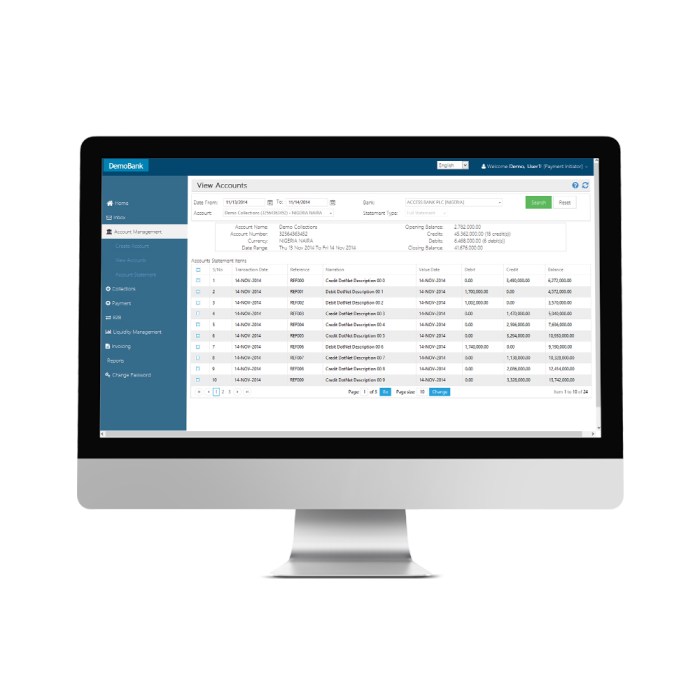
Numerous software solutions are available to support corporate liquidity management. These range from basic cash management systems to comprehensive treasury management systems (TMS) offering integrated functionalities. TMS platforms typically include modules for cash forecasting, bank account reconciliation, payment processing, and financial reporting. Some advanced TMS solutions incorporate artificial intelligence (AI) and machine learning capabilities for enhanced forecasting, risk management, and decision support.
For example, a large multinational corporation might utilize a TMS that integrates with its enterprise resource planning (ERP) system to provide a real-time view of its global cash positions. This allows the treasury team to efficiently manage cash across multiple jurisdictions and optimize its liquidity across the entire organization. Another example could be a smaller company using cloud-based cash management software that simplifies bank reconciliations and automates payment processes, freeing up staff time for more strategic activities.
Automation in Streamlining Liquidity Management Operations
Automation is a key driver of efficiency in modern liquidity management. Automating routine tasks such as bank reconciliations, payment processing, and reporting frees up treasury staff to focus on more strategic activities, such as optimizing working capital and managing liquidity risk. Robotic process automation (RPA) can handle repetitive tasks with high accuracy and speed, reducing manual errors and improving overall efficiency.
Furthermore, automation enables real-time monitoring of cash flows and liquidity positions, allowing for quicker identification and response to potential issues. For instance, an automated system could trigger alerts if a company’s cash balance falls below a predefined threshold, allowing for prompt action to avoid liquidity shortfalls. Another example is the automated matching of invoices and payments, reducing the time and resources required for reconciliation.
This streamlined process ensures accurate financial reporting and enhances overall operational efficiency.
In conclusion, mastering corporate liquidity management is not merely a financial function; it’s a strategic imperative for long-term viability and prosperity. By proactively assessing risks, implementing sophisticated tools, and adhering to robust governance frameworks, corporations can navigate financial uncertainty, capitalize on opportunities, and achieve sustainable growth. The integration of technology and a forward-looking approach are paramount in ensuring effective liquidity management in today’s complex business environment.
A well-managed liquidity position is the bedrock of a resilient and successful enterprise.
Key Questions Answered
What are the consequences of poor liquidity management?
Poor liquidity can lead to missed payment deadlines, inability to meet operational expenses, difficulty securing credit, and ultimately, business failure.
How often should a company review its liquidity position?
Regular reviews, ideally monthly or quarterly, are essential to monitor cash flow, identify potential issues, and adjust strategies proactively.
What role does the CFO play in liquidity management?
The CFO is typically responsible for overseeing the overall liquidity strategy, working with treasury and finance teams to ensure sufficient funds and efficient management of cash flow.
How can technology improve liquidity forecasting accuracy?
Data analytics and advanced forecasting software can enhance accuracy by incorporating real-time data, identifying trends, and improving predictive modeling.


