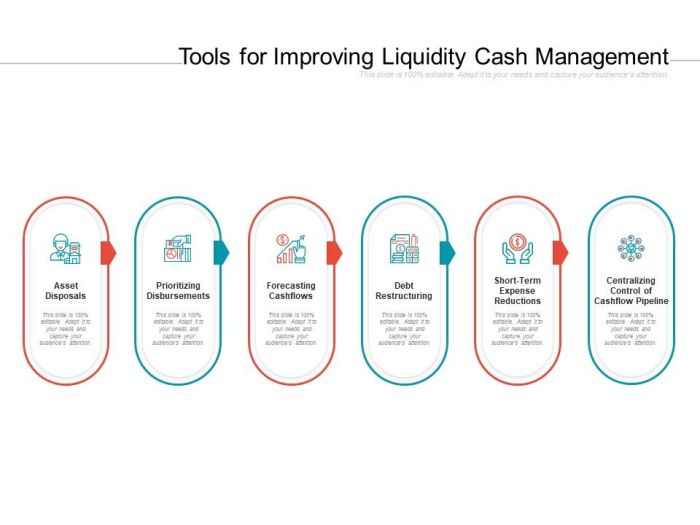
In today’s dynamic business landscape, efficient cash flow management is paramount. Automated liquidity management tools are emerging as crucial solutions, offering businesses the ability to optimize their financial resources and navigate market uncertainties with greater confidence. These tools leverage advanced technologies to forecast, analyze, and manage liquidity, ensuring businesses maintain sufficient funds to meet their obligations and capitalize on opportunities.
This guide delves into the functionalities, benefits, integration challenges, security considerations, and future trends associated with these transformative tools.
From streamlining daily operations to predicting potential cash flow shortfalls, automated liquidity management systems offer a range of advantages. They empower businesses to make data-driven decisions, improve forecasting accuracy, and ultimately enhance their financial stability. Understanding the various tools available, their integration processes, and the potential risks involved is key to harnessing their full potential and achieving optimal financial health.
Integration with Existing Systems
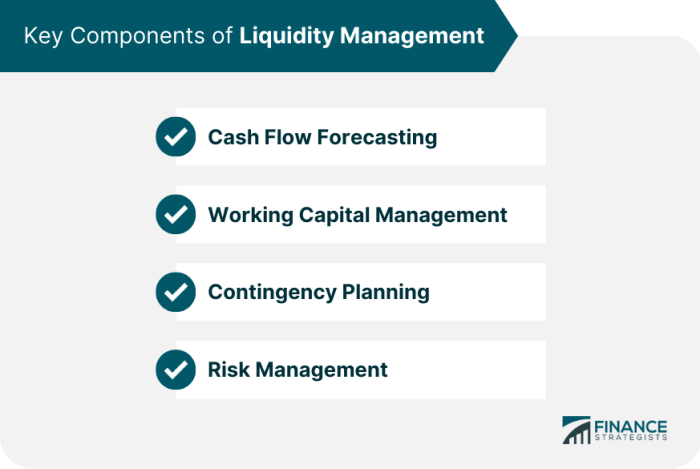
Seamless integration with existing financial systems is crucial for the successful implementation of automated liquidity management tools. Effective integration minimizes manual data entry, reduces errors, and streamlines the overall financial process, providing a holistic view of liquidity positions. This section details how these tools connect with various systems and addresses potential challenges.Integrating automated liquidity management tools involves connecting them to various existing systems within a company’s infrastructure.
This often requires a combination of application programming interfaces (APIs), data extraction, transformation, and loading (ETL) processes, and potentially custom-built integrations depending on the specific systems involved. The goal is to automate the flow of financial data, minimizing manual intervention and ensuring data accuracy.
Integration with Enterprise Resource Planning (ERP) Systems
Automated liquidity management tools integrate with ERP systems by leveraging APIs to access real-time data on accounts receivable, accounts payable, cash flow projections, and other relevant financial information. This allows the tool to build a comprehensive picture of the organization’s liquidity position, taking into account all relevant financial transactions processed within the ERP. For example, an ERP system might provide data on upcoming invoices, enabling the tool to accurately forecast future cash inflows.
This integration ensures that the liquidity management tool has a complete and accurate view of the organization’s financial health, leading to more informed and effective liquidity management decisions. The specific integration methods vary depending on the ERP system (e.g., SAP, Oracle, Microsoft Dynamics 365) and the liquidity management tool, but generally involve secure API connections and data mapping to ensure accurate data transfer.
Integration with Accounting Software
Integrating automated liquidity management tools with accounting software is typically achieved through similar methods as with ERP systems: utilizing APIs to access and transfer data. This allows for the automatic import of transactional data, such as bank statements, payment records, and general ledger entries. The accounting software acts as a source of truth for financial transactions, providing the liquidity management tool with the necessary data to perform its analysis and forecasting functions.
This integration eliminates the need for manual data entry, reduces the risk of human error, and improves the efficiency of the overall financial process. For example, a small business using QuickBooks could integrate its accounting software with a liquidity management tool to automatically update cash flow projections based on new invoices and payments recorded in QuickBooks. The accuracy and timeliness of this data integration are crucial for the effective functioning of the liquidity management tool.
Challenges in Integrating with Legacy Systems
Integrating automated liquidity management tools with legacy systems can present significant challenges. Legacy systems often lack robust APIs, making data extraction difficult and potentially requiring costly and time-consuming custom integrations. Data formats in legacy systems may also be incompatible with modern tools, necessitating data transformation processes. Furthermore, security concerns around integrating new tools with older, less secure systems need to be carefully addressed.
For example, a company relying on a mainframe-based accounting system might face substantial challenges in integrating a cloud-based liquidity management tool. Careful planning, potential system upgrades, and the expertise of experienced IT professionals are crucial for overcoming these integration hurdles.
Step-by-Step Guide: Integrating a Hypothetical Tool with a Fictional Accounting System
This guide Artikels the integration of “FlowMaster,” a hypothetical automated liquidity management tool, with “AccountWise,” a fictional accounting system.
- Assessment and Planning: Analyze FlowMaster’s API documentation and AccountWise’s data structure to identify compatible data points and potential integration points. Define clear integration goals and scope.
- API Key Generation and Authentication: Obtain API keys and authentication credentials from both FlowMaster and AccountWise. Securely store these credentials.
- Data Mapping: Map relevant data fields between FlowMaster and AccountWise. This ensures accurate data transfer and consistency.
- API Calls and Data Transfer: Develop or utilize pre-built connectors to facilitate automated data transfer via API calls. This may involve custom scripting or using existing integration platforms.
- Testing and Validation: Thoroughly test the integration to ensure data accuracy and system stability. Conduct both unit and integration tests.
- Deployment and Monitoring: Deploy the integrated system and continuously monitor its performance and data integrity. Implement error handling and logging mechanisms.
Liquidity Management and Logistics Management
Liquidity management and logistics management, while seemingly disparate, share significant interconnectedness impacting a company’s overall financial health and operational efficiency. Both disciplines focus on optimizing the flow of resources, albeit different types: liquidity management focuses on the flow of cash and short-term assets, while logistics management centers on the flow of goods and materials. Understanding their interplay is crucial for businesses aiming for robust financial performance and streamlined operations.
The core principles of these two management styles, while distinct in their focus, share underlying similarities. Liquidity management emphasizes maintaining sufficient cash reserves to meet immediate obligations, manage short-term debt, and capitalize on investment opportunities. It involves forecasting cash inflows and outflows, managing working capital, and securing access to credit lines. Logistics management, conversely, concentrates on the efficient and effective flow of goods from origin to consumption, encompassing procurement, warehousing, transportation, and inventory management.
Its primary goals are cost reduction, timely delivery, and customer satisfaction.
Overlapping Areas and Synergies
Effective logistics management directly impacts liquidity. Efficient inventory management minimizes storage costs and reduces the need for extensive working capital tied up in unsold goods. Streamlined transportation reduces lead times, enabling faster payments from customers and improving cash flow predictability. Conversely, robust liquidity allows for investments in advanced logistics technologies, such as automated warehousing systems or optimized transportation routes, leading to further improvements in efficiency and cost reduction.
A company with strong liquidity can leverage this to negotiate better terms with suppliers, leading to improved payment cycles and increased cash flow.
Logistics Management’s Contribution to Improved Liquidity
Several key aspects of logistics contribute to enhanced liquidity. Firstly, optimized inventory management minimizes capital tied up in stock. Just-in-time inventory systems, for example, significantly reduce warehousing costs and the risk of obsolescence, freeing up capital for other purposes. Secondly, efficient transportation and delivery systems ensure timely payment collection from customers. Faster delivery means quicker invoice processing and reduced days sales outstanding (DSO), improving cash flow.
Thirdly, strong supplier relationships fostered through effective logistics management can lead to favorable payment terms, extending payment periods and easing cash flow pressures. Finally, reduced logistics costs directly increase profitability, contributing to higher overall cash reserves.
Visual Representation of Effective Logistics and Improved Cash Flow
Imagine a flowchart. The starting point is “Efficient Logistics Operations,” branching into three main components: “Optimized Inventory Management” (leading to reduced storage costs and faster inventory turnover), “Streamlined Transportation & Delivery” (leading to faster payment collection and reduced DSO), and “Strong Supplier Relationships” (leading to favorable payment terms). These three components converge into a central point labeled “Improved Cash Flow,” which then flows into “Increased Liquidity” as the final outcome.
The visual emphasizes the direct causal relationship between effective logistics management and improved cash flow, ultimately contributing to enhanced liquidity.
Future Trends in Automated Liquidity Management
Automated liquidity management is rapidly evolving, driven by advancements in technology and the increasing complexity of financial markets. The future of this field promises more sophisticated systems capable of anticipating market shifts and optimizing liquidity positions with greater precision and efficiency. This section will explore the key trends shaping this transformation.
Artificial Intelligence and Machine Learning Applications
AI and ML are revolutionizing automated liquidity management by enabling predictive analytics and real-time decision-making. These technologies can analyze vast datasets – encompassing market data, transaction history, and economic indicators – to identify patterns and predict future liquidity needs with greater accuracy than traditional methods. For instance, ML algorithms can be trained to forecast short-term interest rate fluctuations, allowing for proactive adjustments to borrowing and lending strategies.
Furthermore, AI-powered systems can optimize portfolio composition to maintain desired liquidity levels while maximizing returns, dynamically adjusting asset allocations based on real-time market conditions. A practical example would be an AI system predicting a sudden increase in demand for a specific currency, prompting the automated sale of assets to meet the anticipated liquidity needs before the price dips.
Predictive Modeling and Scenario Planning
Advanced predictive modeling techniques, powered by AI and ML, are enabling sophisticated scenario planning for liquidity management. These models can simulate various market conditions and assess their potential impact on liquidity positions. This allows businesses to proactively develop contingency plans to mitigate risks and maintain operational stability, even during periods of market turbulence. For example, a model could simulate the impact of a sudden credit crunch on a bank’s liquidity, allowing the institution to preemptively adjust its borrowing and lending strategies to avoid potential insolvency.
This proactive approach contrasts sharply with the reactive measures often taken in the past.
Blockchain Technology Integration
The integration of blockchain technology offers the potential to enhance transparency, security, and efficiency in automated liquidity management. Blockchain’s decentralized and immutable nature can improve the traceability and verification of transactions, reducing the risk of fraud and enhancing trust among participants. Furthermore, smart contracts can automate liquidity management processes, reducing reliance on manual intervention and minimizing the potential for human error.
A concrete example could be the use of smart contracts to automatically trigger the release of funds from a decentralized finance (DeFi) protocol when certain liquidity thresholds are reached. This ensures a continuous and reliable supply of liquidity without human intervention.
Enhanced Data Security and Compliance
As automated liquidity management systems become increasingly sophisticated, the need for robust data security and compliance measures will also grow. The use of advanced encryption techniques and robust access controls is crucial to protect sensitive financial data from unauthorized access and cyber threats. Compliance with evolving regulatory frameworks, such as GDPR and CCPA, will be essential for maintaining the integrity and trustworthiness of these systems.
Implementation of advanced cybersecurity protocols, regular security audits, and continuous monitoring of system activity are vital components of ensuring data security and regulatory compliance. The increasing reliance on cloud-based solutions will necessitate robust cloud security measures to protect data stored in the cloud.
The Future Landscape of Automated Liquidity Management (Conceptual Model)
Imagine a future where liquidity management operates seamlessly across various financial ecosystems. A central hub, powered by AI and ML, constantly monitors market data, economic indicators, and internal financial information. This hub utilizes predictive modeling to anticipate future liquidity needs and automatically adjusts asset allocation, borrowing, and lending strategies in real-time. Blockchain technology ensures the secure and transparent execution of transactions, while robust security measures protect sensitive data.
This system integrates seamlessly with existing systems, optimizing liquidity across various departments and subsidiaries. The overall effect is a highly efficient, proactive, and resilient liquidity management system capable of navigating even the most volatile market conditions. This model represents a shift from reactive to proactive management, optimizing not just liquidity but also risk mitigation and overall financial performance.
Automated liquidity management tools represent a significant advancement in financial technology, providing businesses with the means to proactively manage their cash flow and mitigate financial risks. By understanding the functionalities, benefits, and potential challenges associated with these tools, businesses can make informed decisions about their implementation and reap the rewards of enhanced financial control and stability. The future of liquidity management is undeniably intertwined with technological advancements, promising even more sophisticated and efficient solutions in the years to come.
Embracing these innovations will be crucial for businesses seeking to thrive in an increasingly competitive market.
Quick FAQs
What are the typical costs associated with implementing an automated liquidity management tool?
Costs vary widely depending on the chosen tool, its features, and the level of customization required. Expect expenses related to software licensing, implementation services, training, and ongoing maintenance.
How long does it typically take to implement an automated liquidity management system?
Implementation timelines depend on factors like system complexity, data migration requirements, and internal resources. Projects can range from a few weeks to several months.
What are the key performance indicators (KPIs) used to measure the effectiveness of an automated liquidity management system?
KPIs may include improved forecasting accuracy, reduced days sales outstanding (DSO), decreased reliance on short-term borrowing, and enhanced cash flow visibility.
Can these tools integrate with different accounting software platforms?
Many tools offer integration capabilities with various accounting software platforms, but compatibility should be verified before implementation. Some may require custom integrations.


